In the quiet kitchens of Asia, a culinary phenomenon has been quietly perfected over generations, now capturing the fascination of home cooks worldwide: the art of the perfect guotie, or potsticker, crowned with a delicate, lace-like lattice known as the "ice flower." This isn't merely a cooking technique; it's a dance of heat, water, and starch, a chemical ballet that transforms humble ingredients into a textural masterpiece. The secret, as any seasoned dumpling master will whisper, lies not in a special pan or a magical ingredient, but in the precise and almost alchemical ratio of water to starch.
The quest for the ultimate ice flower begins with understanding its very nature. That beautiful, crispy, and intricate web that fuses the bottoms of the dumplings together is not ice at all, but a network of gelatinized and then dehydrated starch. When a starch-water slurry hits the searing hot oil in a well-seasoned pan, a series of rapid transformations occur. The water instantly vaporizes, steaming the dumplings from the top while aggressively frying the starch from below. The starch granules, suspended in the water, swell, burst, and then interlink, forming a gelatinous film. As the cooking process continues and all the water eventually evaporates, this film dries out in the intense residual heat, solidifying into the brittle, golden, and breathtakingly complex structure we so desire.
This is where the magic of the ratio becomes paramount. A mixture that is too watery, with a low starch concentration, will simply steam away without leaving enough solid material behind to form a substantial lattice. The result is a pale, spotty, and fragile crust that shatters at the mere touch of a chopstick. It lacks structural integrity and visual drama. Conversely, a mixture too thick with starch will create a paste-like slurry that fails to spread evenly across the pan. It will cook into a dense, thick, and often burnt pancake—a stodgy blanket that glues the dumplings together but offers none of the ethereal crispness or visual lacework. It becomes a barrier rather than a highlight.
After years of experimentation, countless batches of sacrificed dumplings, and consultations with both professional chefs and grandmothers who measure with their hearts, a golden ratio has emerged for the ideal balance. For every one part of starch—whether it be the common wheat starch found in standard flour, the pure clarity of cornstarch, or the unique texture of rice flour—you should aim for approximately ten to twelve parts water by volume. This creates a slurry that is milky and fluid, yet has enough body to promise a solid structure. For example, one tablespoon of cornstarch mixed with ten tablespoons of cold water is a fantastic and reliable starting point for a standard 10-inch pan. This ratio provides just enough starch particles to form a continuous, strong network without becoming overly thick or gloppy.
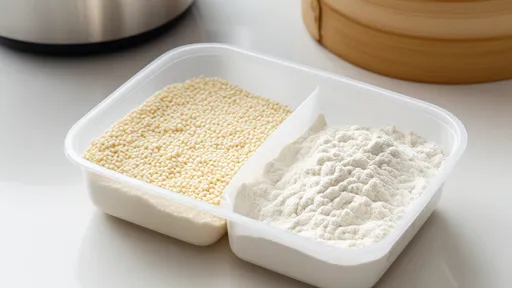
However, the recipe is not a rigid prison; it is a framework for artistry. The type of starch you choose will paint different characteristics onto your ice flower. All-purpose flour, containing both starch and gluten, will yield a slightly more bready and substantial crust with a darker golden color and a robust crunch. Cornstarch is the purist's choice, famous for creating the most classic, glass-like, and intricately laced crystal patterns with a clean, sharp snap. Rice flour or even tapioca starch can introduce a different kind of crispness—slightly harder and more glassy, sometimes with a subtle chewiness at the very center if not fully dehydrated. Many virtuosos of the pan even advocate for a blend, such as a 2:1 ratio of cornstarch to rice flour, to achieve a hybrid crunch that is both intricate and durable.
Mastering the slurry is only half the battle. The technique of its application is what separates a good attempt from a spectacular victory. The pan must be screaming hot—properly preheated over medium-high heat with a good quality neutral oil until it shimmers. The dumplings should be arranged neatly, their flat bottoms making contact to develop a initial sear. Once they are positioned, the cold starch water is poured confidently into the pan, usually around the edges to avoid washing away the oil from under the dumplings. It should sizzle and bubble aggressively upon contact. Immediately, a tight-fitting lid is clamped on to trap the erupting steam, which is crucial for cooking the tops of the dumplings through.
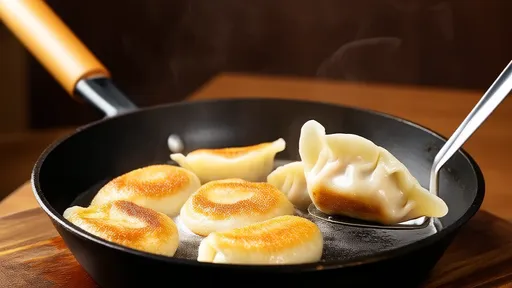
The final, most critical phase is the unveiling. After most of the sizzling has subsided, indicating the water has evaporated, the lid is removed. This allows the remaining moisture to escape, ensuring the starch network dries out completely instead of steaming into soggy failure. What remains is that beautiful, golden-brown lacework connecting the dumplings. The final test of perfection is the release. A thin, flexible spatula is slid underneath the entire network. A perfectly executed ice flower will detach from the pan in one glorious, connected sheet, a crispy tapestry showcasing your culinary skill. It should audibly crackle as it's lifted, a sound as satisfying as its appearance.
So, the next time you set out to make guotie, remember you are not just frying dumplings. You are conducting an experiment in food science and embracing an ancient culinary art form. Arm yourself with a simple slurry of one part starch to ten parts water, respect the heat of your pan, and have the patience to listen to the sizzle. Your reward will be more than a meal; it will be a masterpiece of texture and taste, crowned with the perfect, crispy, golden ice flower.
By /Aug 20, 2025
By /Aug 20, 2025
By /Aug 20, 2025
By /Aug 20, 2025
By /Aug 20, 2025
By /Aug 20, 2025
By /Aug 20, 2025
By /Aug 20, 2025
By /Aug 20, 2025
By /Aug 20, 2025
By /Aug 20, 2025
By /Aug 20, 2025
By /Aug 20, 2025
By /Aug 20, 2025
By /Aug 20, 2025
By /Aug 20, 2025
By /Aug 20, 2025
By /Aug 20, 2025
By /Aug 20, 2025
By /Aug 20, 2025